
Talk to One of Our Experts 704-964-8588
Talk to One of Our Experts 704-964-8588
Running a commercial space in Charlotte means safety codes can't take a back seat. If an emergency hits, nobody wants people bottlenecked at an exit door. Slapping a crash bar on your main exit doors lets anyone push their way out in a split second with no keys or struggling required. Local fire marshals are strict about this, and whether you run a restaurant, retail shop, office, or warehouse, proper panic hardware is usually mandatory to pass inspection. Getting it installed right keeps you legal, avoids fines, and gets everyone out safely if things go sideways
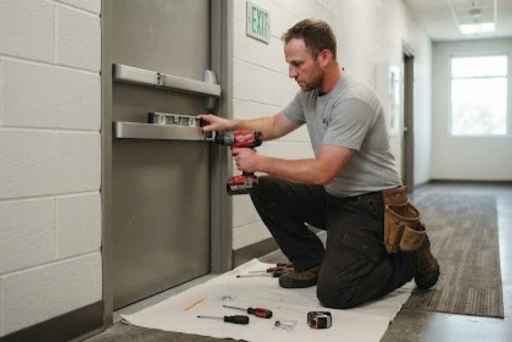
Panic bars, also called crash bars or exit devices, allow occupants to open a door simply by pushing against the bar, without needing to twist a knob or locate a key. Fire and building codes generally require this hardware on doors serving high occupancy spaces, including restaurants, retail stores, schools, and assembly halls where a large number of people could need to exit quickly. If your Charlotte property falls into one of these categories, an exit device is not optional. Business owners often discover the requirement only after an inspector flags the issue, which is why proactive planning matters far more than a last minute fix. An emergency locksmith service Charlotte team can respond quickly if a hardware failure or lockout puts your building at risk before that assessment happens.
An exit device is any hardware designed to let occupants leave a building without special knowledge, a key, or more than one motion, and panic bars are the most common type installed on commercial doors. Whether panic hardware is required on a specific door depends on the room's occupant load, the building's use group, and the door's role in the egress path. The right option would be to turn to the experts from locksmith services in Charlotte that will ensure that your space's capacity is calculated as well as the right place for installing panic mechanisms has been chosen so that you comply with the law and do not spend money where it is not necessary.
Not every locksmith is equipped to handle panic bar installation correctly. This work requires knowledge of fire codes, door hardware compatibility, and proper alignment so the device functions every single time it is needed. When comparing commercial locksmith services in Charlotte, ask about experience with exit devices specifically, since installation mistakes can cause the bar to jam or fail to latch. A poorly installed panic bar is arguably worse than none at all, because it creates a false sense of security while leaving your building out of compliance.
A trusted provider will also walk you through maintenance schedules, since panic bars see heavy daily use and need periodic adjustment. This is different from the lighter demands of residential locksmith services in Charlotte , where door traffic and code requirements are far less intense. Commercial buildings need hardware rated for constant use and technicians who understand the difference between panic bars, fire-rated exit devices, and standard push bars. Choosing a locksmith who works across both commercial and residential settings gives you a single point of contact for every property you manage.
A common point of confusion for business owners is how a panic bar door locks and unlocks, since the hardware has to allow free exit from the inside while still controlling entry from the outside. Most commercial panic bars pair with a separate outside trim, cylinder, or keypad that controls entry, while the push bar itself always releases the latch from the inside, regardless of whether the door is locked to outside traffic. This means a panic bar door never locks behind occupants trying to leave. Staff can unlock the door for outside entry with a key or code without ever affecting the free exit function required by code. If you are unsure whether your current hardware meets this standard, One Stop Locksmith can inspect it during a routine visit.
Panic bar installation rarely happens in isolation, either. Once a technician inspects your exit doors, they often find related issues that affect how well the hardware performs. Sagging doors, misaligned frames, and worn hinges all interfere with proper closure and latching, which is why door hinges repairs in Charlotte often come up during the same visit. A full-service locksmith can also support the rest of your property, from automotive locksmith services in Charlotte for a locked-out company vehicle to car lockout services in Charlotte for staff and customers in your parking lot.
Business owners are not limited to Charlotte proper when it comes to code compliance. Many companies operate across the metro area, including nearby Fort Mill and Rock Hill, South Carolina. A Fort Mill locksmith familiar with both North Carolina and South Carolina requirements can install panic bars correctly no matter which side of the state line your property sits on. This matters because permit and inspection processes can vary slightly between jurisdictions, and a locksmith who only works in one city may not be up to date on both
The same is true for a Rock Hill locksmith, since businesses in this growing area increasingly need the same commercial-grade hardware as their Charlotte counterparts. Whether you need a locksmith in Fort Mill SC for a single storefront or a locksmith in Rock Hill SC to service a multi-location operation, working with a provider who covers the whole region simplifies scheduling and keeps your compliance records consistent. Using a single service provider will eliminate the problem of filling in paperwork for every site.
The installation of panic bars is a part of the regulations, however, it is more than just complying with the law. The One Stop Locksmith can help ensure that this requirement is handled properly and It will pay off in the long run by ensuring that a safe exit is available for people going in and out of the premises. If a business chooses to wait for inspectors to give them the citation for not installing panic bars, they risk exposing the employees and visitors to potential emergencies. Getting ahead of the requirement now means one less thing to worry about the next time your building faces an inspection or an emergency
Panic hardware is generally required on exit doors serving spaces with a high occupant load, such as restaurants, retail stores, schools, and assembly halls. A locksmith or code official can confirm the exact requirement for your building.
An exit device is any hardware, including a panic bar, that lets occupants leave a building quickly without a key or special knowledge. It is required on qualifying doors to keep evacuation routes fast and reliable.
The push bar itself never locks from the inside, since free exit is required at all times. Entry from the outside is controlled separately through a keyed cylinder, trim, or keypad installed alongside the panic hardware.
People walking up to the exterior side just use a standard key or punch in a code on the trim attached to the bar to open it. This controls who can enter without affecting how occupants exit from inside.
Yes. You can easily rekey the exterior cylinder on the outside without swapping out the whole panic bar setup whenever you need to change who has access.